The Range Rover Sport L320 is one of the most popular vehicles we dismantle at our Southend-on-Sea facility. They come in regularly — high mileage, engine failure, gearbox issues or simply end of life. This particular vehicle is a 2.7 TDV6 — engine code 276DT — Land Rover's diesel V6, fitted to the L320 Sport from 2005 to 2009 and shared with the Discovery 3.
What makes the L320 276DT particularly interesting to dismantle is the engine removal process. Unlike most vehicles where the engine comes out through the top of the engine bay, the 2.7 TDV6 276DT in the L320 requires the body to be lifted clean off the chassis — a full body-off procedure — before the engine can be properly accessed and removed.
Here's exactly how we do it at our licensed ATF on Stock Road, Southend-on-Sea.
The Vehicle — Range Rover Sport L320 2.7 TDV6 276DT
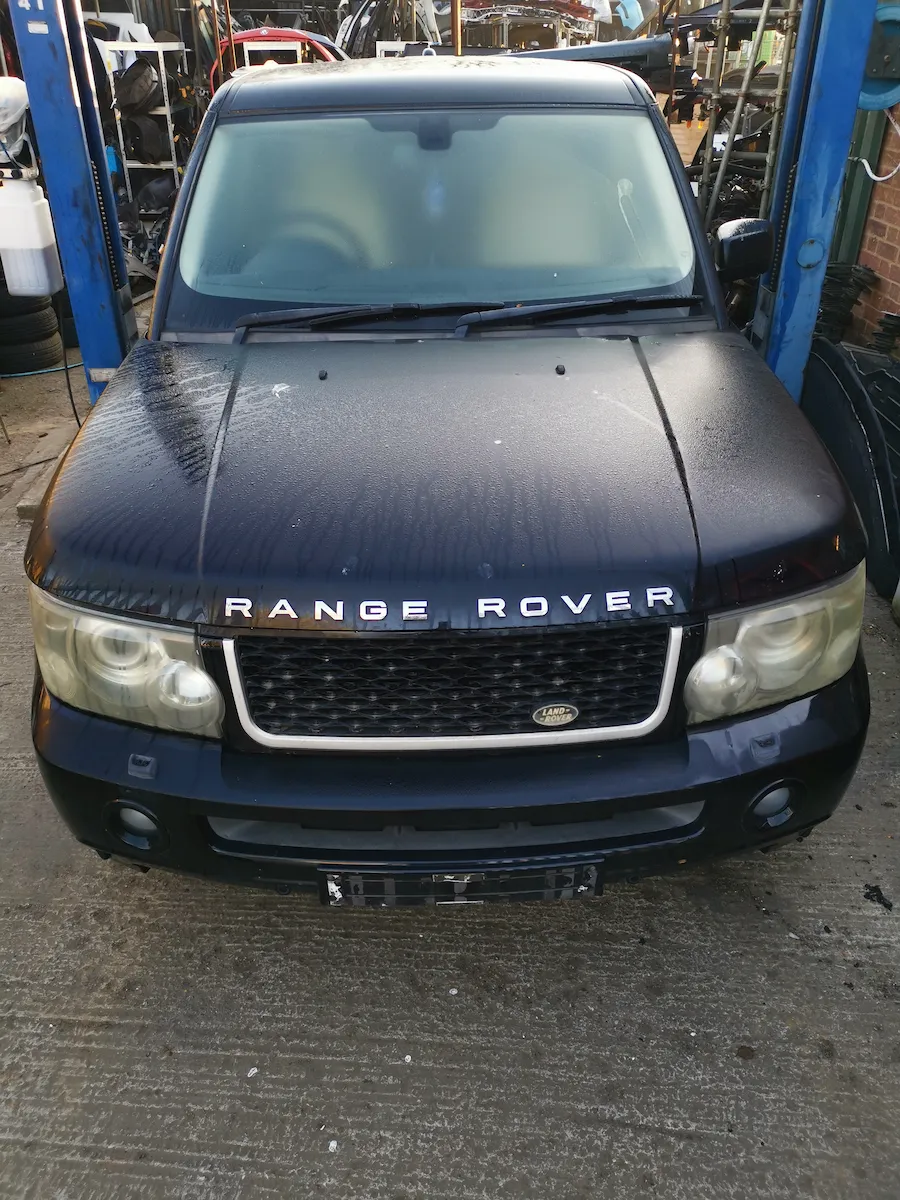
The L320 Sport was produced from 2005 to 2013 and is built on a ladder-frame chassis — the same basic architecture as the Discovery 3 and 4. This body-on-frame construction is what makes it both extremely capable off road and unusually complex to work on compared to a monocoque car.
The 276DT engine — also known as the 2.7 TDV6 or AJD-V6 — is a 2,720cc twin-turbocharged diesel V6 jointly developed by Ford and PSA. It produces around 190bhp and is generally regarded as a solid unit when properly maintained. When neglected it is prone to oil starvation issues, timing chain problems and injector failures — which is why many examples end up with us.
Step 1 — Depollution First
Before any dismantling begins the vehicle is fully depolluted as required by our Environment Agency licence. Proper depollution is what separates a licensed Authorised Treatment Facility from an unregistered operation. Unlicensed scrap dealers skip this step — fluids end up in the ground, contaminating soil and water. As a licensed ATF holding Permit JP3029SM we are legally required to depollute every vehicle fully before processing.
On the L320 276DT this means draining and safely disposing of:
- Engine oil — typically 8–10 litres including the filter
- Coolant — the 276DT runs a substantial cooling system due to the twin-turbo setup
- Diesel fuel — extracted from the tank under the load floor
- Brake fluid — front and rear circuits
- Power steering fluid
- Air conditioning refrigerant — reclaimed using specialist equipment
- 12V battery — removed and sent for specialist battery recycling
- Catalytic converter — removed for precious metal recovery
- Airbag canisters — safely deactivated
Only once the vehicle is fully depolluted do we move to stripping.
Step 2 — Stripping the Interior and Exterior
Before the body lift can happen we strip out everything that could be damaged in the process and everything that has resale value. On the L320 this is substantial — these vehicles are full of desirable used parts.
Interior parts we remove include seats, door cards, the dashboard assembly, centre console, infotainment system, carpets, headlining and all glass where undamaged. Exterior stripping covers the front bumper, grille, bonnet, front wings, doors, rear bumper and boot lid.
All parts with value are cleaned, photographed and listed on our eBay parts store — available to Land Rover and Range Rover owners across the UK.
Step 3 — The Body Lift
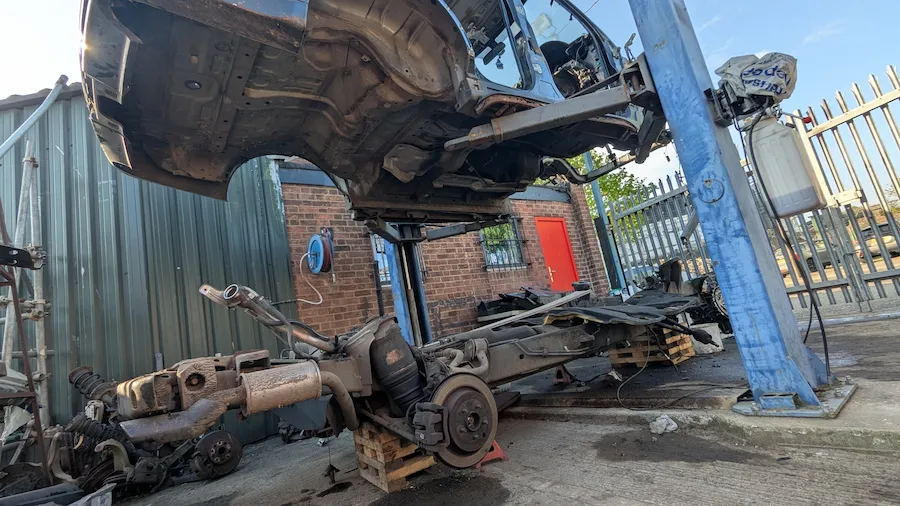
This is the step that makes the L320 276DT different from most vehicles we process. The 2.7 TDV6 engine cannot be removed from above or below with the body in place — the engine is effectively trapped between the front subframe and the bulkhead. The only practical solution is to lift the entire body off the chassis.
To prepare for the body lift we disconnect:
- All wiring harness connectors between body and chassis
- Brake lines at the flexible hose connections inside the wheel wells
- Fuel lines at the body-to-chassis junction
- The gear selector linkage
- The handbrake cables
- The steering column at the intermediate shaft
- All body-to-chassis mounting bolts — eight main points on the L320
With everything disconnected, the body is lifted using our ramp — rising clear of the chassis, engine and running gear beneath it. It is one of those moments that looks genuinely dramatic in a workshop — a full size SUV body suspended in the air while the chassis, 276DT engine and suspension sit flat on the floor beneath.
Step 4 — Removing the 276DT Engine
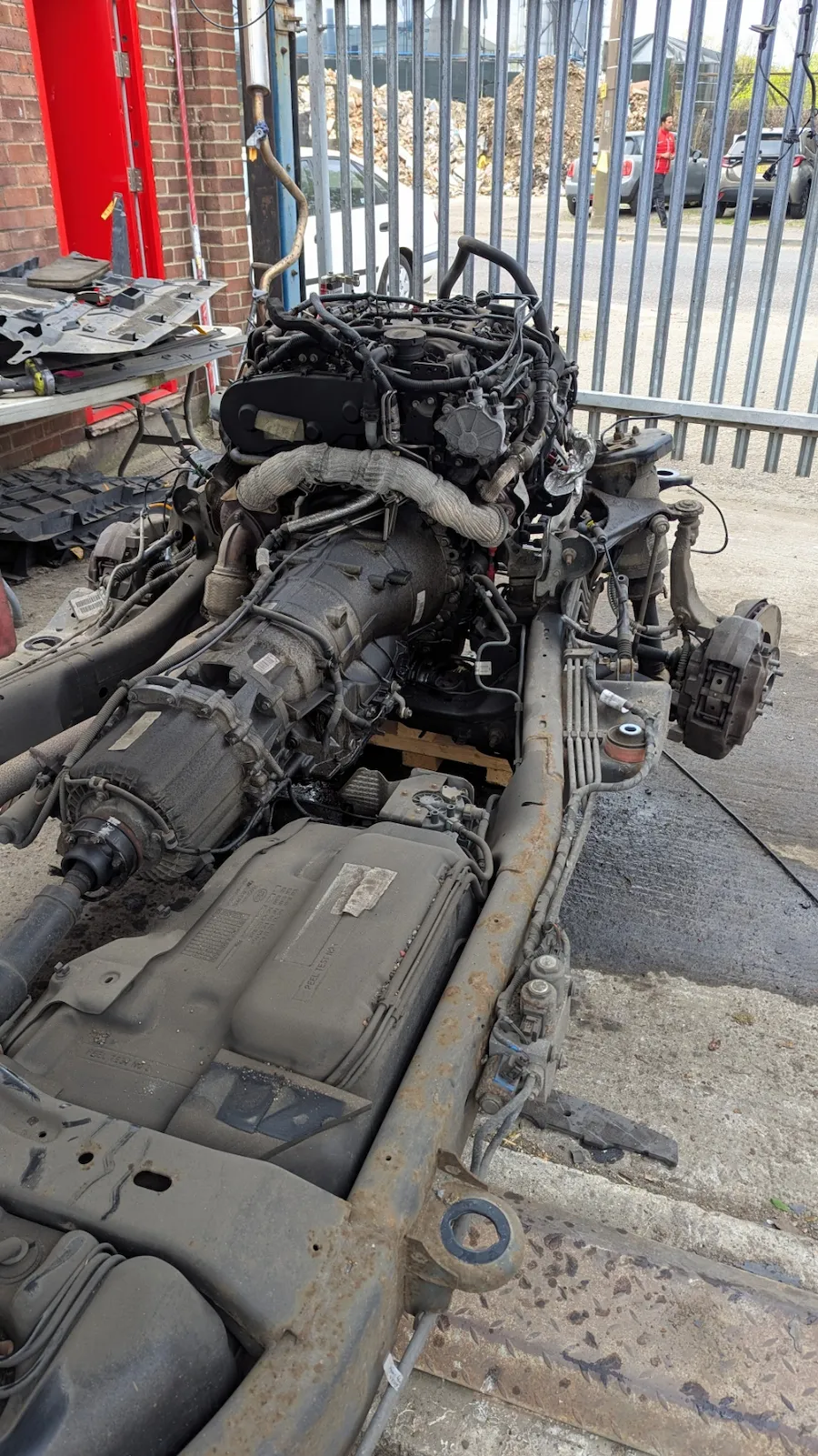
With the body lifted clear, the 276DT 2.7 TDV6 is now fully accessible. We can see the complete engine, both turbochargers, the transmission, front differential, propshaft and all ancillaries without any obstruction.
The engine is unbolted from the ZF 6-speed automatic gearbox and lifted out using an engine crane. On the 276DT the twin turbos add complexity — both units are removed carefully as they carry significant resale value, particularly the high-pressure turbo which is a well-known failure item on these engines.
Step 5 — Stripping the 276DT Engine
Once removed, the 276DT is assessed and stripped further. Ancillaries, sensors, the intake manifold, alternator, power steering pump and both turbochargers are removed and assessed individually. What's viable for resale is listed. What isn't goes for recycling.
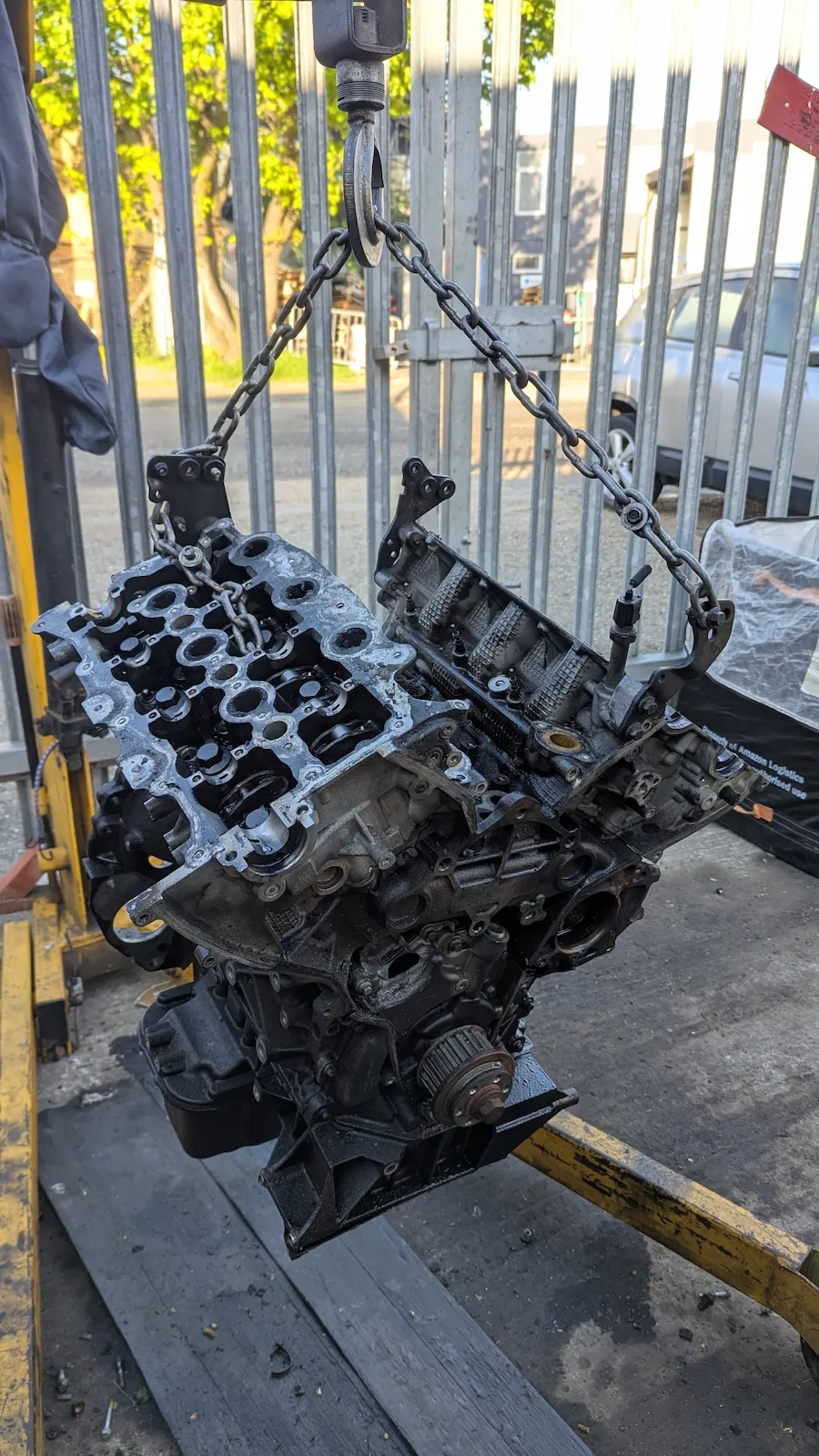
The engine block itself — once all usable parts are removed — is sent to a specialist metal recycler along with the chassis and body shell. We achieve a recycling rate of over 95% on every vehicle we process. Nothing goes to landfill.
Other drivetrain components removed at this stage include the ZF 6HP26 automatic gearbox, the transfer case, front and rear differentials and both propshafts. All go through the same assessment — listed for sale if viable, recycled if not.
276DT and L320 Parts Available
The L320 276DT generates a substantial inventory of used parts. Parts we commonly list from these vehicles include:
- 276DT twin turbos — high-pressure and low-pressure units — among the most searched parts for this engine
- 276DT engine ancillaries — alternator, power steering pump, intake manifold, sensors
- ZF 6HP26 automatic gearbox
- Transfer case
- Air suspension compressor and components — a very common L320 failure item
- Front and rear air suspension bags
- Front and rear differentials
- Steering rack
- Brake callipers and carriers
- Body panels and lights
- Interior — seats, dashboard, door cards, infotainment
- Alloy wheels
- ECU and electrical modules
If you're looking for a specific part from a Range Rover Sport L320 or a 276DT engine, check our eBay parts store or call us on 01702 612000 — we may have your part in stock or have another L320 coming in shortly.
Why Use a Licensed ATF to Scrap Your Land Rover?
When you scrap a vehicle with a licensed Authorised Treatment Facility like Amber Autos LTD, you receive a Certificate of Destruction within 7 days. This legally removes the vehicle from your name and proves it has been properly processed. You cannot get a CoD from an unlicensed dealer — and without one you remain legally responsible for the vehicle.
We also notify the DVLA on your behalf — your road tax refund is triggered automatically. No paperwork for you to deal with.
Read more about how we dismantle scrap cars at our Southend-on-Sea facility, or find out what happens to a car when it's scrapped. We also cover car breakers across Essex if you're looking for used parts from other makes.
Scrap your Land Rover or Range Rover in Essex
Free collection across Southend-on-Sea and Essex — bank transfer on collection — Certificate of Destruction within 7 days
Get a Free Quote or call 01702 612000Need to scrap your car in Southend-on-Sea?
Get a free instant quote from Amber Autos LTD — free collection, bank transfer on collection, DVLA paperwork handled.
Get a Free Quote Call Now